Introduction:
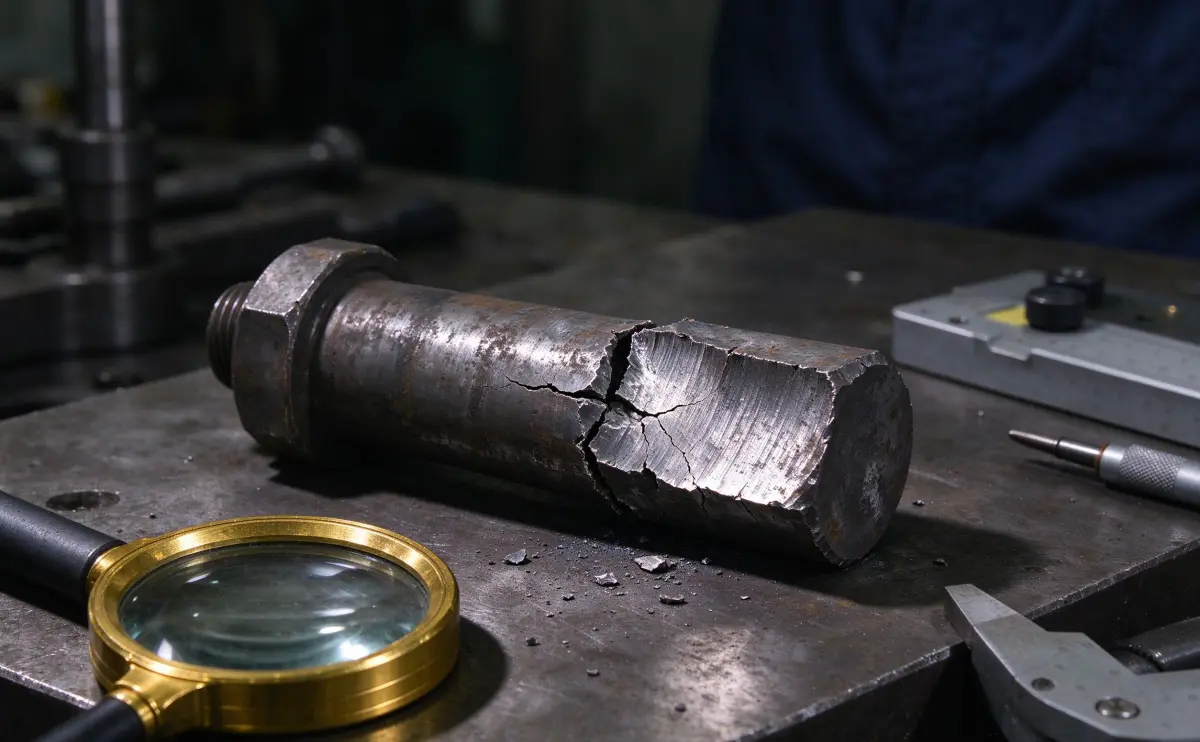
No manufacturer ever wants to see a broken bolt. But in the real world of heavy machinery, construction, and automotive applications, failures happen. The difference between a mediocre supplier and a great one is not whether they ever have a failure, but how they respond to it. This image—showing a fractured bolt under a magnifying glass—captures our commitment to forensic engineering and root-cause analysis.
The Anatomy of a Broken Bolt
The bolt in the photo has sheared completely. To an untrained eye, it’s just scrap metal. To our engineers, it’s a puzzle. Was it a ductile overload (the bolt was simply too weak for the load)? Was it fatigue (the bolt failed after millions of cyclic vibrations)? Or was it hydrogen embrittlement (a hidden danger caused by improper electroplating)?
Our Forensic Process
We don’t guess; we test. When a client sends us a failed part, we perform a comprehensive Failure Analysis:
-
Visual Inspection: Using a magnifying glass or stereo microscope to examine the fracture surface (the “beach marks” or “chevron patterns” tell a story).
-
Hardness Testing: To verify if the material meets the required grade (e.g., Grade 8.8 vs. 10.9).
-
Metallurgical Analysis: We examine the microstructure to check for improper heat treatment.
-
Scanning Electron Microscopy (SEM): For the most complex cases, we use advanced lab equipment to see the failure at a microscopic level.
Turning Failure into Knowledge
The goal of this analysis is not to assign blame; it is to prevent recurrence. If we find that the failure was due to a design flaw in your assembly process, we will tell you. If it was a defect in our manufacturing, we will fix it and replace the parts at no cost.
Conclusion
You need a supplier who stands behind their products long after the invoice is paid. Our technical team is ready to support you with engineering expertise, not just sales pitches. If you are facing a fastener challenge, reach out to us—we speak the language of engineering.